An Absence of Performing
Abbey of Our Lady of Gethsemani — Kentucky
I went to a monastery and accidentally started studying humans.
Again.
To be fair, this is becoming a problem.
I had gone to the Abbey of Our Lady of Gethsemani because I love being there. I had my journal with me because I had recently decided that apparently I am now the kind of person who carries a field notebook around and writes things like:
How do our postures change when we are simply acknowledged?
Completely normal retreat behavior.
So I watched.
People eating.
People walking.
People praying.
People sitting alone.
And, because my brain has apparently decided that nothing is allowed to simply exist anymore without becoming a question, I started noticing what people carried.
Crosses. Religious images. The little visible things that made sense in a Catholic monastery.
And then—
a mandala.
On a bag.
That was all.
Nobody was performing an exotic spiritual ritual in the dining room. Nobody had joined a monastery in Tibet.
It was a bag.
But I noticed it.
More specifically, I noticed that I noticed it.
The Christian imagery around me had already become visually expected. My brain barely needed to process it.
But the mandala looked different.
Why?
Did it mean something religious to the woman carrying it? Maybe.
Was it just a pretty bag?
Also maybe.
Was I about to assign an entire spiritual identity to a stranger based on her accessories?
George, put the anthropology down.
I didn’t know what the bag meant.
But suddenly I had a better question:
How quickly do we learn what looks like it belongs?
And there went the rabbit.
Silence is weird.
Human beings aren’t particularly good at leaving silence alone.
Put two strangers in an elevator and watch what happens.
We look at numbers.
Phones.
Shoes.
Anything that prevents us from acknowledging the astonishing fact that another human being is standing fourteen inches away from us and neither of us knows what to do about it.
Silence frequently feels like a social problem requiring a solution.
Gethsemani does something different with it.
Silence is part of the place.
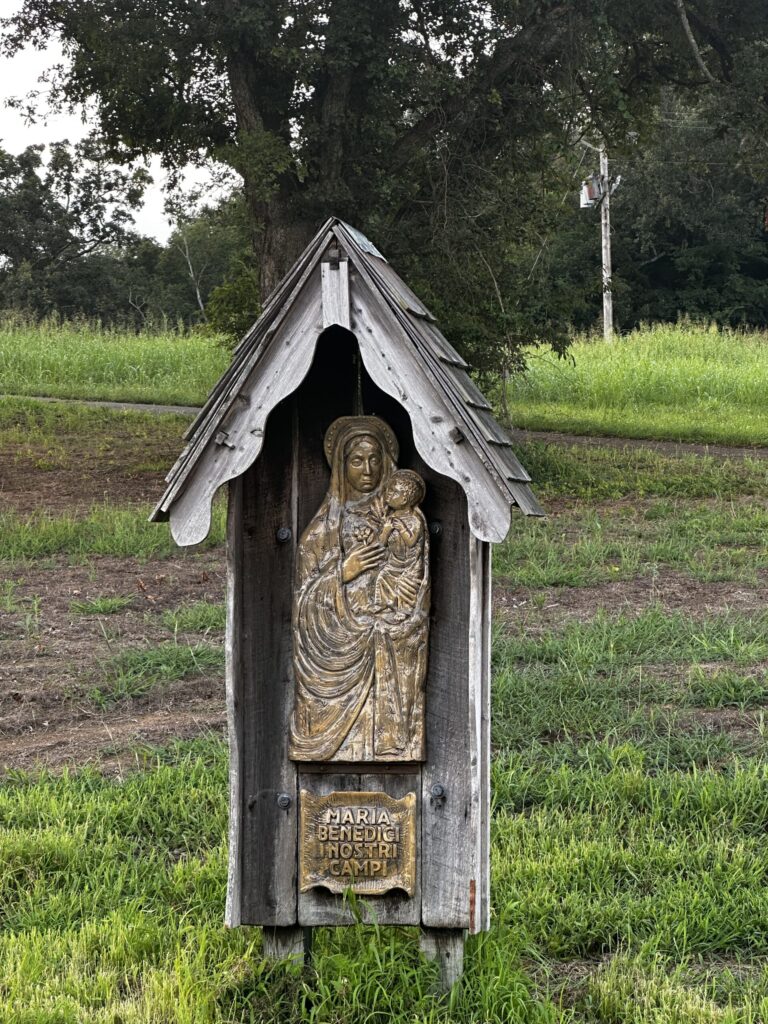
The Abbey was founded in 1848 by Trappist monks, and the community that lives there today still orders its life around prayer, work, sacred reading, meals, community and silence.
And when I say orders its life, I mean it.
Vigils.
Lauds.
Terce.
Sext.
None.
Vespers.
Compline.
Seven periods of communal prayer punctuate the monks’ day.
There are places where talking is acceptable and places where quiet is expected. Bells mark time. Meals have rhythms. People move differently through the church than they do through the coffee area, the library or the woods.
This place has rules.
Lots of them.
Which makes what I wrote in my notebook rather inconvenient:
I felt free.
That made no sense to me.
So naturally I started poking at it.
Apparently the coffee area has its own anthropology.
One of the things I began noticing was that the Abbey wasn’t really one social space.
It was a collection of them.
People behaved differently depending on where they were.
Church had one rhythm.
The dining room had another.
The library another.
The trails another.
And then there was coffee.
Coffee, it turns out, remains coffee even at a monastery.
People lingered.
The physical space hadn’t transported us outside Gethsemani. We were still inside the same culture of retreat and silence.
But something shifted.
People could talk there.
They gathered differently.
Bodies oriented toward one another differently.
People stayed.
And suddenly I was interested in the threshold itself.
What happens when we move from a space where one behavior is expected into a space where another becomes permissible?
And what happens to our bodies when the rules change?
That question wasn’t completely new.
Before coming to Gethsemani, I had an encounter with a stranger that had left me thinking about something incredibly ordinary: acknowledgment.
What happens physically when someone realizes they’ve been seen?
I’m a massage therapist. Bodies are already part of the way I understand people. I notice guarding. Posture. Breath. Tension. Orientation. The tiny shifts humans make around one another.
So I wrote:
How do our postures change when we are simply acknowledged?
Not what is that person feeling?
I can’t know that.
Just—
what changed?
And now I was walking around a monastery watching what happened to bodies when the social environment changed.
Apparently I had brought work with me.
Then I wrote six words.
At some point, this landed in the notebook:
Gratitude for an absence of performing.
And I stopped.
Because…
what did I mean by that?
I wasn’t surrounded by people pretending to be someone else.
I didn’t mean performance as dishonesty.
It was something subtler.
The little negotiations we make all day long in the presence of other people.
Am I talking enough?
Too much?
Should I smile?
Do I look approachable?
Do I look competent?
Do I know where I’m supposed to stand?
Should I say something?
Does this person think I’m rude?
Do I belong here?
And perhaps the sneakiest one:
How do I show them that I belong here?
At Gethsemani, I could eat alone without explaining why I was alone.
I could walk without telling anyone where I was going.
I could sit silently beside another human being without either of us being responsible for filling the silence.
I didn’t have to be interesting.
Or funny.
Or useful.
I didn’t have to entertain the table.
I could just sit at it.
And somewhere in there I started wondering whether what I was experiencing wasn’t simply silence.
Maybe it was relief from constantly producing evidence that I deserved my chair.
Well.
That’s a considerably bigger rabbit.
Day Two: George becomes the specimen.
The next note makes me laugh now.
Most of my observations turned inward.
Excuse me?
That was not the arrangement.
I was supposed to be observing the field.
Apparently the field had other plans.
As the retreat continued, the direction of my attention changed.
At first I was watching people.
Then I began watching my own responses.
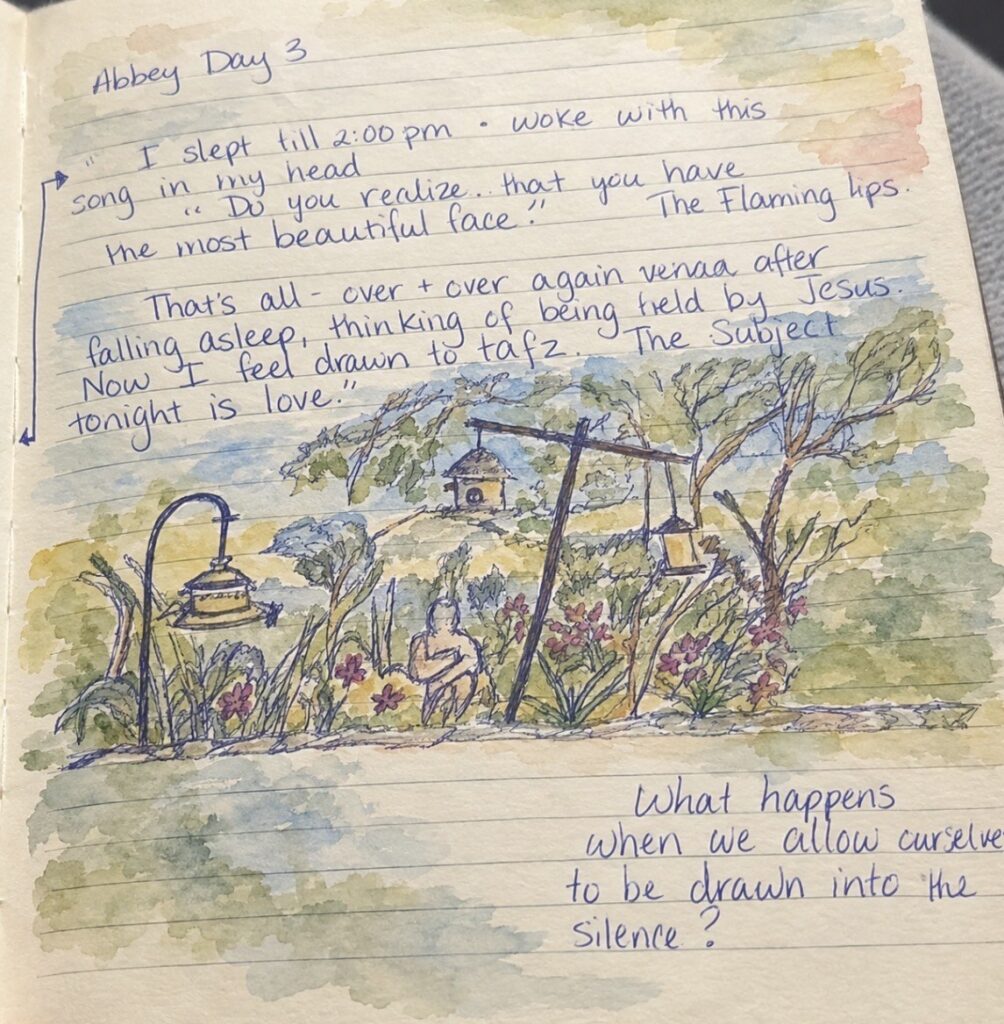
By Day Three, I was drawing.
Not drawing because I had decided I needed an illustration for Tribal-ology.
Just sitting there long enough to notice the shape of the Abbey against the landscape and wanting to put it on paper.
I noticed stones.
Water.
Trees.
A butterfly.
A chipmunk.
Little things that normally lose the competition for my attention.
And I wrote another question:
What happens when we allow ourselves to be drawn into the silence?
I don’t think I understood what I was asking yet.
I may still not.
But something had happened to the observer.
Looking had become noticing.
Noticing had become listening.
And somewhere along the way I had wandered into my own field notes.
And then I left evidence.
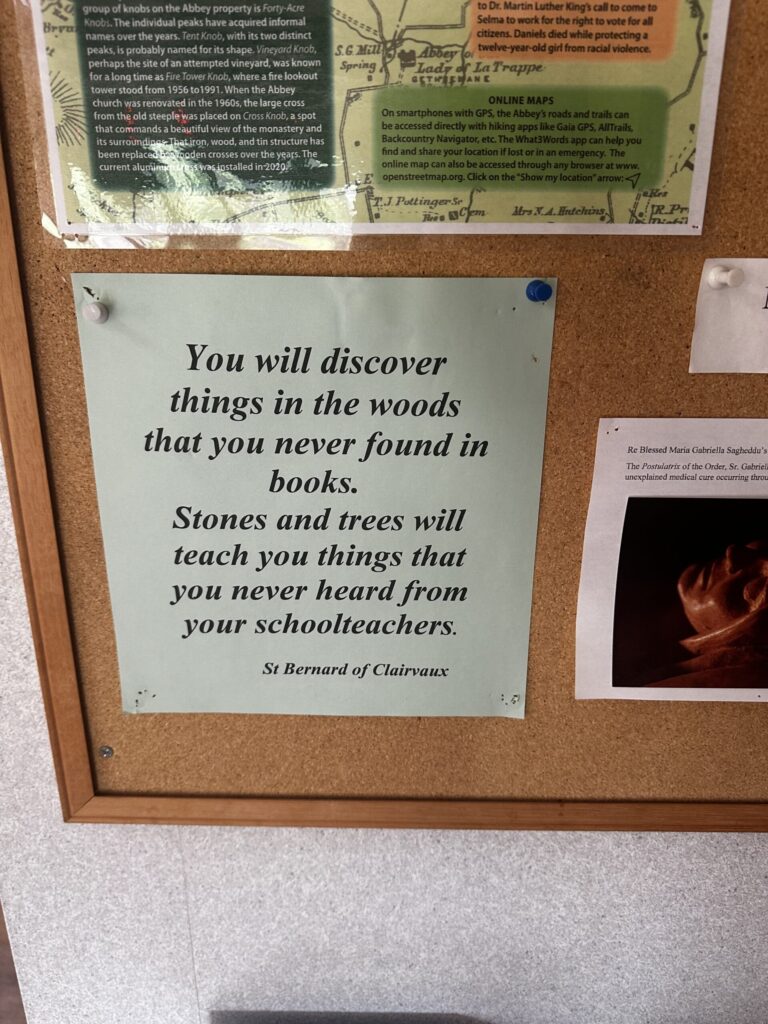
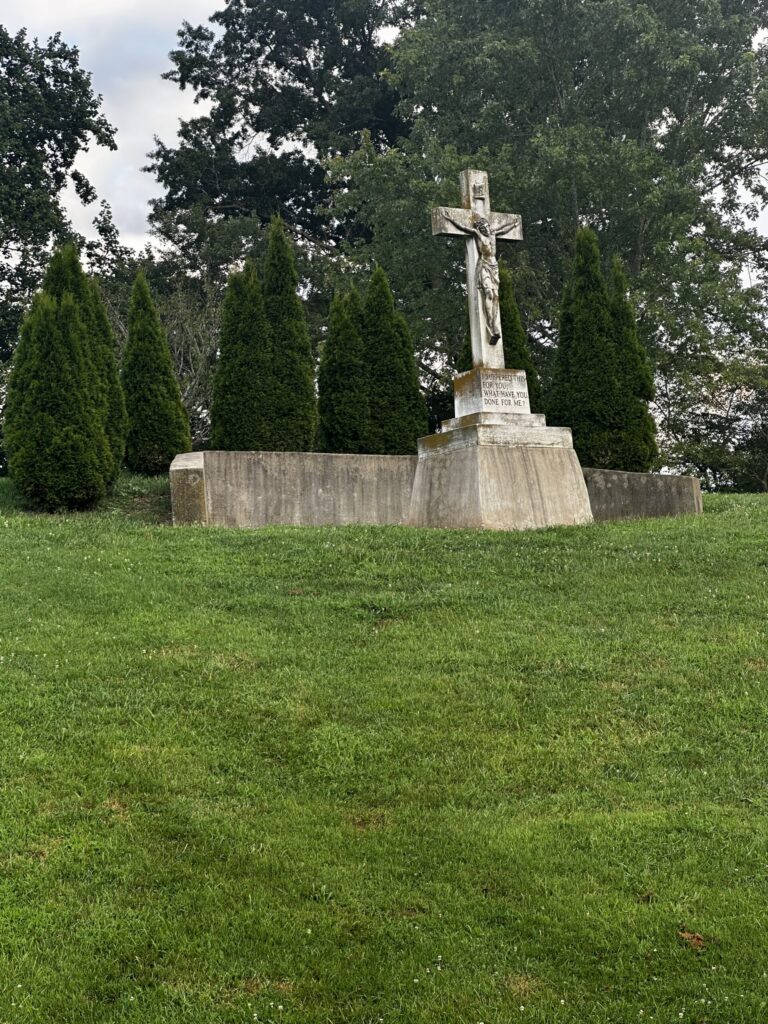
There is a large cross on Cross Knob overlooking the Abbey landscape.
The cross itself already has a biography. It once stood on the Abbey church steeple and was moved into the landscape after renovations in the 1960s.
I love that.
An object can move without becoming the same object in the same way.
Put a cross on a church steeple and it does something.
Put that cross on a hill where people climb toward it, pray beneath it and leave objects around it…
Does its meaning change?
Accumulate?
Both?
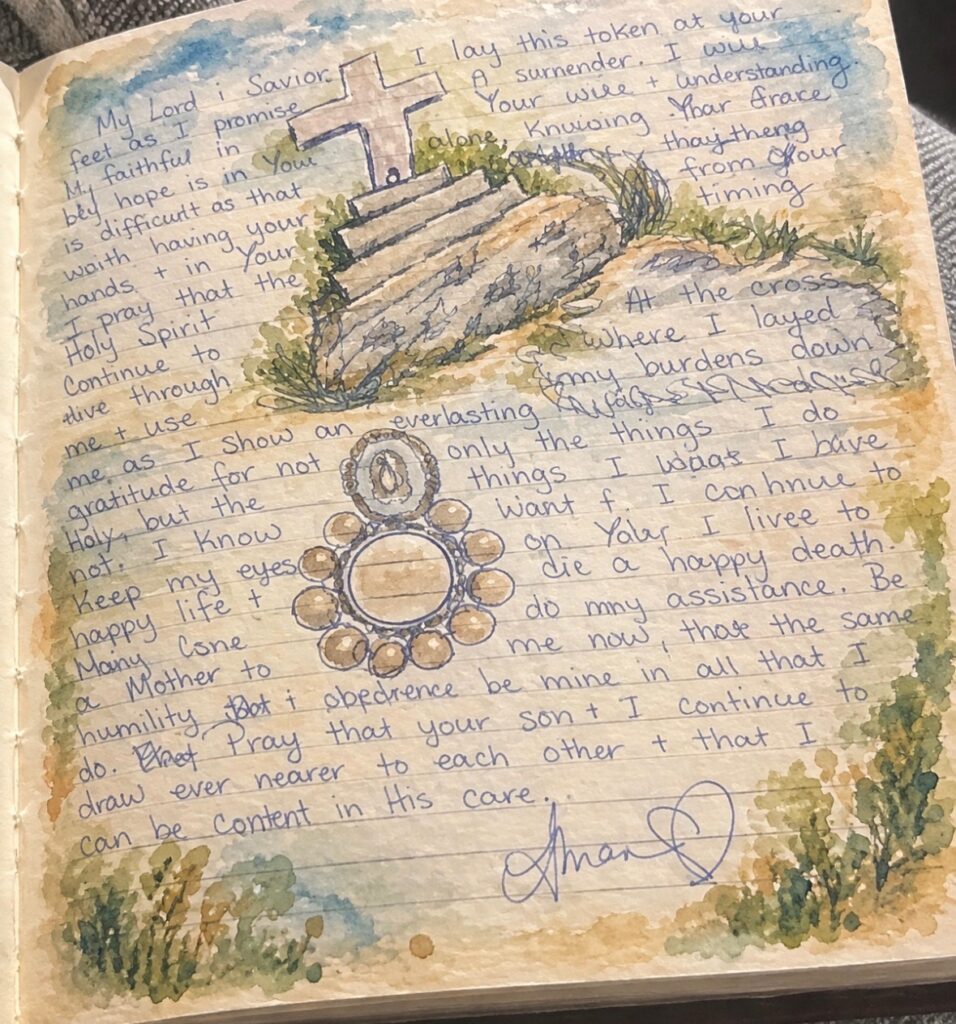
I had a small rosary ring with me.
And I did something that would later make the archaeology part of my brain go absolutely feral.
I prayed into it.
My childhood.
Things I was grateful for.
Things I needed to release.
My children.
Questions.
Guidance.
The prayer I had written in my journal.
I climbed the stones beneath the cross, put the ring there—
and left without it.
At the time, it was prayer.
Later, I realized:
I had made an artifact.
Oh.
Ohhhhh.
Archaeologists are in so much trouble.
Imagine someone finds that ring years from now.
What can the object tell them?
It’s a rosary ring.
It was found at the base of a Christian cross.
Other devotional objects have been left in the surrounding stones.
Those are useful pieces of context.
An archaeologist could document the object, its location, its relationship to the landscape and perhaps reasonably interpret it as devotional material.
But here’s what they cannot recover:
My childhood.
The names I prayed.
What I was releasing.
Why I chose that particular object.
Why I left it that particular day.
The entire invisible biography of the thing disappeared the moment I walked away.
The artifact survived.
The meaning didn’t.
Or at least not all of it.
And that realization made every museum case I have ever stared into slightly more suspicious.
How much invisible luggage are objects carrying that we can never unpack?
Which brings us, naturally, to a rock.
Because this is how my brain works.
While exploring the grounds, I found a large stone.
And something about it looked…
placed.
Maybe.
I took pictures.
Pulled out the compass.
Recorded where I was.
Looked around.
There was water nearby.
There was evidence of landscaping.
I started wondering whether the stone had been intentionally positioned.
Retaining wall?
Old garden structure?
Something from an earlier use of the land?
I had questions.
I had photographs.
I had coordinates.
What I did not have was evidence.
Later, I learned more about the garden use of the area, which gives me additional things to investigate.
It does not magically turn my rock into an archaeological feature.
And suddenly my rosary ring and my suspicious rock were sitting beside one another in my brain.
With the ring, I know the story but a future observer wouldn’t.
With the rock, I can see the object but I don’t know the story.
One warns me how much interpretation can miss.
The other warns me how much interpretation can invent.
That may be one of my favorite things the Abbey taught me:
Observation is not interpretation.
Sometimes further research changes everything.
Sometimes the exciting archaeological discovery is:
Yep. Rock.
Science is cruel.
Then Numbers showed up.
I know.
We were having such a nice time.
But I couldn’t stop thinking about the fact that this incredibly structured place had made me feel unusually free.
And that dragged me back to something I had already been thinking about while reading the Bible anthropologically.
The Book of Numbers.
Numbers is much more interesting when you stop treating all those tribes, censuses, camp arrangements and responsibilities as biblical paperwork.
These are people who have been liberated.
They’ve left Egypt.
Great.
Now what?
How does a population become a people?
Where does everybody camp?
Who moves first?
Who is responsible for what?
Who belongs to whom?
What are the boundaries?
What happens when somebody violates them?
When do we move?
When do we stop?
How do people who have been freed from one social order learn to inhabit another?
How do you teach people to be free?
And suddenly Gethsemani didn’t feel contradictory anymore.
Maybe freedom isn’t the absence of structure.
Maybe the question is what the structure does to the person inside it.
Does it give you somewhere to stand?
Or does it require you to make yourself smaller in order to remain there?
And THAT is when my brain produced a phrase that sounds suspiciously like I should have tenure somewhere:
Provable belonging apparatus.
😂
I made that up.
But I know exactly what I mean by it.
Show me your membership card.
Human groups are spectacularly creative at making belonging visible.
Clothing.
Language.
Ritual.
Food.
Credentials.
Badges.
Names.
Objects.
Stories.
Who you know.
Where you sit.
What you know without needing it explained.
How you greet people.
What you carry.
Maybe even the bag on your shoulder.
Not every signal is demanded. Not every one means what an observer assumes it means. And signaling belonging isn’t inherently bad.
Some of these things are beautiful.
They tell us:
These are my people.
But now I had another question.
What happens when belonging requires proof?
And how much of ourselves are we willing to negotiate to provide it?
That question bothered me because Gethsemani had just given me the opposite experience.
I was surrounded by other people.
I was participating in a highly structured environment.
And yet nobody seemed to require me to demonstrate why I deserved to be there.
I didn’t have to produce anything.
Presence was sufficient.
And that is where the whole rabbit hole curled back around to the table.
Maybe that’s what I was grateful for.
Tribal-ology began with belonging.
With this ridiculous, beautiful human habit of finding one another and deciding:
us.
My family.
My church.
My town.
My people.
Our stories.
Our rituals.
Our table.
And I’m increasingly fascinated by everything human beings build around that tiny word.
We.
How do we create it?
How do we recognize it?
How do we preserve it?
What do we carry that tells other people we belong?
What do we change about ourselves to remain inside it?
And—
here’s the uncomfortable one—
At what point does the cost of belonging become the self?
Because there is a difference between giving yourself to a community and disappearing into one.
There is a difference between adapting to other people and negotiating yourself out of existence.
And maybe freedom isn’t having nobody to belong to.
Maybe freedom is being able to belong without ceasing to possess yourself.
I didn’t arrive at Gethsemani with that question.
I arrived with a notebook.
I noticed a bag.
Some bodies.
A coffee area.
A cross.
A rosary ring.
A suspicious rock.
I chased a few rabbits.
And somewhere in the middle of all of it, I wrote six words that I still haven’t managed to get past:
Gratitude for an absence of performing.
Maybe that was the silence.
Not emptiness.
Not isolation.
Not the absence of other people.
Just, for a little while, the absence of needing to convince anyone that I deserved my place among them.
A chair was there.
I sat down.
Nobody asked for proof.
And I think that’s worth carrying into the next field site.
Everyone has a place.
Pull up a chair
Field Reflection #0003
What happens when belonging no longer requires us to prove we deserve our place?
Is silence simply the absence of speech—or can it become a way of participating together?
What changes in our bodies when the expectations of a space change?
And how much of ourselves do we negotiate in order to belong?
I’m not looking for quick answers. I’m collecting observations.
Invisible Luggage
What did the rosary ring carry? To anyone else, it was a small object beneath a cross. But it carried a childhood. Names. Prayers. Gratitude. Things released. Things still hoped for.
The object remained.
The story walked away.
Current Study
Location:
Abbey of Our Lady of Gesthsemani, Kentucky
Research Focus:
Human Belonging, Silence, Material Religion & Social Performance
Current Question:
How do human beings negotiate who they are in order to belong?
The Field is Still Open
This Field Note isn’t finished.
Maybe none of them ever really are.
Have you spent time at Gethsemani?
Do you know something about Cross Knob, the gardens, or how the landscape has changed over time?
Have you left something at the foot of the cross—or encountered devotional objects left there by someone else?
Do you have an old photograph, map, memory, or piece of the Abbey’s story that might change what I’m seeing?
And, perhaps most importantly:
Does anyone know anything about my suspicious rock? 😂
Tell me.
Send something from the field.
Because sometimes new evidence answers the question.
And sometimes—
it’s just a rock.
🐿️ Next Rabbit Hole:
What happens to meaning when the person who gave an object meaning is no longer there to explain it?
Research trail: Material religion • archaeology of deposition • object biography • votive offerings • material culture • archaeological context
Leave a Reply